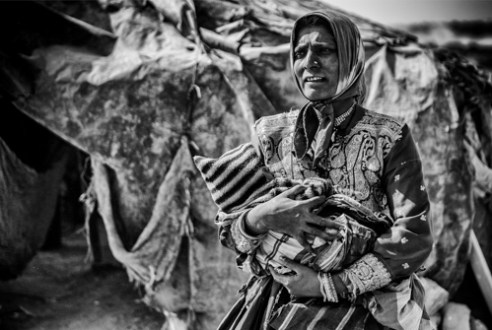
Most women wear a veil in presence of elders, especially in front of their father-in-law. It is a mark of modesty and respect towards the elders of the society.
Along with other 200 tribes Dafars were officially declared as criminal tribes under the British rule. Under the Criminal Act of 1871 anyone born in these tribes was regarded as a criminal. They have carried that stigma to present day. Among the nomadic tribes they are the most discriminated and marginalizedMany nomads work as manual seasonal labour in construction sites or as farm labour.
There are numerous nomadic communities in India who had played an important role in society for many generations. For centuries they had been an integral part of society and respected for providing products, services and seasonal labor as well as entertaining the villagers. Tragically they are now some of the most marginalized people of India. The pace of change has left behind many things once regarded as permanent; the lives of numerous nomadic communities in India are no exception. The relevance and value they brought to the practical and cultural lives of thousands is diminishing; the modern world is creeping in to replace a way of life that had played an important role in society for hundreds of years. Their nomadic existence stems from the need to ply their specialized trades across large areas, with an inherent lifestyle that is now inconsistent with the requirements for addresses and birth certificates and all the other paperwork and procedures stipulated by the ‘Authorities’. The communities become invisible and their ‘outside’ existence now fosters feelings of suspicion and prejudice amongst the mainstream populace.
Nomad children are unlikely to attend school where they would be discriminated against by other children. They spend their time around the campsites.India was once known as land of Snake Charmers. With ban on snake charming most of them now live their life by begging.Sandhi Woman working in salt pans in searing heat. Their feet are exposed to salt water over prolonged periods. When cremated their ankles do not disintegrate like rest of the body.This Mir woman was recently married. She will wear the ornaments at all times as there is nowhere else for safekeeping. Jewelry will serve as a bank account – buy or sell as required because there is no guarantee of family income.With traditional ways gone most Nomads will try to find whatever work is available to earn a living.Here a boy is looking after his brother at a construction site where the parents were working. Children are often taken to work places because there is no one to look after them at home.Here children are at a school run by a charity. They are given food to entice them to attend school and at the same time keep them healthy.Gadalia woman with traditional rings around the upper arms.Without a birth certificate and address it is difficult to register at a school. Modern requirements are inflexible.Young girls normally help out with home chores like milking goats and cooking.Here a Dafer father was cutting vegetable while the child played on the floor.Vasfoda woman with her children at home. At night they would put the blankets (seen on the pile) on the floor to sleep on. Many of these makeshift tents are swept away in Monsoon rains.